AnyCoins logoAnyCoins

Lincoln cent · 1955 · Philadelphia

1955 Doubled Die Penny: What It’s Worth and How to Spot One

A real 1955 doubled die penny sold for $2,379 in lightly worn condition in September 2026, and uncirculated ones bring $7,930 to $21,960. The finest known sold for $320,625 in 2025. Look at the date and LIBERTY: on the real coin both are plainly doubled, with no magnifier needed.

Updated October 22, 2026 · 4 sources

Scan your coin with AnyCoinsFree on iPhone · first 3 appraisals on us
A 1955 doubled die penny, with the doubled date and LIBERTY
A 1955 doubled die obverse cent
Year and mint
1955, Philadelphia (no mint mark)
What’s different
Doubled date, LIBERTY and IN GOD WE TRUST
How many
About 40,000 struck, about 24,000 released
Survivors
About 3,000 to 4,000 in all grades
Variety
FS-101, PCGS #2825 (BN), #2826 (RB), #2827 (RD)
Metal
95% copper, 5% tin and zinc · 3.11 g

What it’s worth

Condition is everything. These are real auction results from the last two years, including the buyer’s premium. Red (RD) coins still have their original copper color, Red-Brown (RB) are partly toned and Brown (BN) are fully toned.

ConditionPriceSale
AU55, lightly worn$2,379Heritage, September 2026 · source
AU58, lightly worn (CACG)$3,416Heritage, May 2026 · source
MS64 Red-Brown, uncirculated$7,930Heritage, late summer 2026 · source
MS64 Red-Brown, uncirculated (CAC)$14,640Stack’s Bowers, June 2026 · source
MS64 Red, uncirculated$21,960Heritage, January 2026 · source
MS65 Red, gem (PCGS, CAC)$90,000Heritage, early 2025 · source
$320,625The record: PCGS MS65+ Red (CAC), the Stewart Blay coin, GreatCollections, February 23, 2025. The same coin had sold for $287,156.25 in January 2023. · source

The jump from MS64 to MS65 Red is huge because so few exist: only 19 coins have graded MS65 Red at PCGS and none finer than MS65+ (PCGS population, late September 2026).

How to tell if you have one

  1. Check the date says 1955 and there is no letter under it. Every real doubled die was struck in Philadelphia, which put no mint mark on cents. A 1955-D or 1955-S can’t be one.
  2. Look at the date. On the real coin every digit has a clear second outline, like a shadow print. You can see it without a magnifier.
  3. Look at LIBERTY and IN GOD WE TRUST. They are doubled too. If only the last 5 looks fuzzy, it isn’t this coin (see below).
  4. The second outlines are rounded and raised, like part of the design. Flat, shelf-like edges mean machine doubling, which is common and adds no value.
  5. Turn it over. The wheat side is not doubled. Then have it checked: valuable coins are worth certifying with PCGS or NGC before you sell.
1955 doubled die penny: the date and LIBERTY are doubled
Doubled die. The date and LIBERTY have a clear second image.
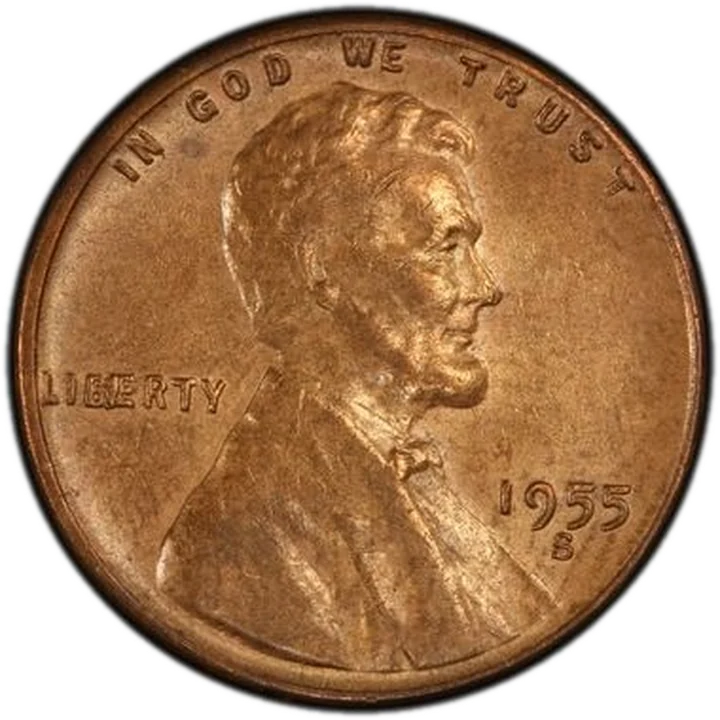
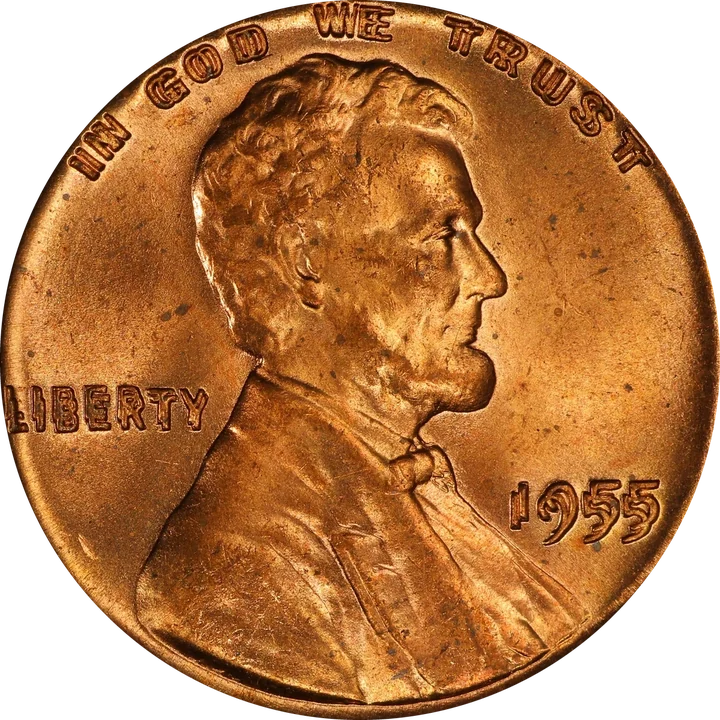
A normal 1955 penny with clean letters
Normal 1955. Clean, single letters and numbers.

Coins that fool people

Machine doubling

The most common lookalike. A loose die bounces as it strikes, leaving flat, shelf-like edges on one side of the letters. Real die doubling is rounded and raised. Machine-doubled coins are worth face value.

The “poor man’s doubled die”

A 1955 cent where only the last 5 looks blurry or doubled, from a worn-out die. It’s a real 1955 variety, but it sells for a small fraction of the real thing.

Counterfeits

Fakes copy the real coin closely, some down to its die markers. If yours looks right, have it certified by PCGS or NGC before buying or selling.

The story

In 1955 the Philadelphia Mint was short of cents and ran two 12-hour shifts. One of its working dies had been made with misaligned impressions from the master hub, so everything on the heads side came out twice, slightly offset.

The die went into service on an overnight shift. Mint workers caught the problem, but by then about 40,000 doubled cents had been struck and mixed in with millions of normal ones. Officials decided against destroying the whole batch, and about 24,000 went out into circulation.

Many of them were handed out as change in cigarette packs. Vending machines charged 23 cents a pack, and distributors slipped two cents under the cellophane. Much of the early supply turned up around Boston, western Massachusetts and upstate New York.

Because the doubling is visible without a magnifier, it became the coin that taught America to check its change. Dealers advertised for it on comic books and matchbooks, and it’s still the most famous error coin in the country.

Is yours a 1955 doubled die?

Before you sell it or put it back in the jar, scan it. AnyCoins tells you whether it’s the real doubled die, a poor man’s doubled die or a normal 1955, and what the same coin has sold for.

  1. Open AnyCoins and photograph the heads side, then the tails side, in good light.
  2. AnyCoins identifies the coin and checks it for known errors and varieties.
  3. You see its condition estimate, a price range by condition and what the same coin has sold for.
Download on the App Store

Why collectors use AnyCoins

  • Photograph both sides and it names the coin: country, year, mint and denomination.
  • Values from real sales: a price range by condition and recent sales of the same coin, not a guess.
  • A condition estimate from your photos, so you know which row of the price table you’re in.
  • Checks the coin for known errors and varieties, the kind that turn a cent into thousands.
  • Melt value for silver and gold, and the mint that struck it on the Mint Map.

Questions people ask

How much is a 1955 doubled die penny worth?

Real examples sold for $2,379 lightly worn (AU55, Heritage, September 2026) and $7,930 to $21,960 uncirculated in 2026. The finest known sold for $320,625 in February 2025.

How do I know if my 1955 penny is a doubled die?

The date, LIBERTY and IN GOD WE TRUST are all clearly doubled, with rounded, raised second outlines you can see without a magnifier. There is no mint mark under the date.

Is a 1955 penny with a D worth anything?

A 1955-D can’t be the doubled die, which was only struck in Philadelphia.

How many 1955 doubled die pennies are there?

About 40,000 were struck and about 24,000 were released. An estimated 3,000 to 4,000 survive today.

Should I clean my 1955 penny?

No. Cleaning leaves marks that collectors and grading services spot right away, and it can cut the value of a real doubled die by thousands.

Sources

  1. CoinWeek: The Penny That Taught America to Check Its Change (October 6, 2026)
  2. PCGS CoinFacts: 1955 1C Doubled Die Obverse, RD
  3. NGC: Face Value: 1955 Cents
  4. CoinNews: 1955 Cent Sells For Record $125,000 (2020)

Prices are public auction results including the buyer’s premium unless marked as a price guide. A coin’s value depends on its exact condition and on having it certified by a grading service such as PCGS or NGC.